
CAN DEPALLETIZERS
CODI's depalletizers are the first step in an automated beverage packaging line, pulling empty cans from inbound pallets and feeding them into the line. Systems range from the manual DPL-100 for small and mobile operations to the fully automatic DPL-1000 running up to 1,400 cans per minute. Our RPL-1000 repalletizer and Flex Stack gantry system round out end-of-line palletizing for finished product.
DPL-100 COMPACT
DEPALLETIZER

AUTOMATION: Operator-assisted
SPEED: ~100 CPM
SUITABLE FOR: Compact and mobile lines
DPL-250 STANDARD
DEPALLETIZER
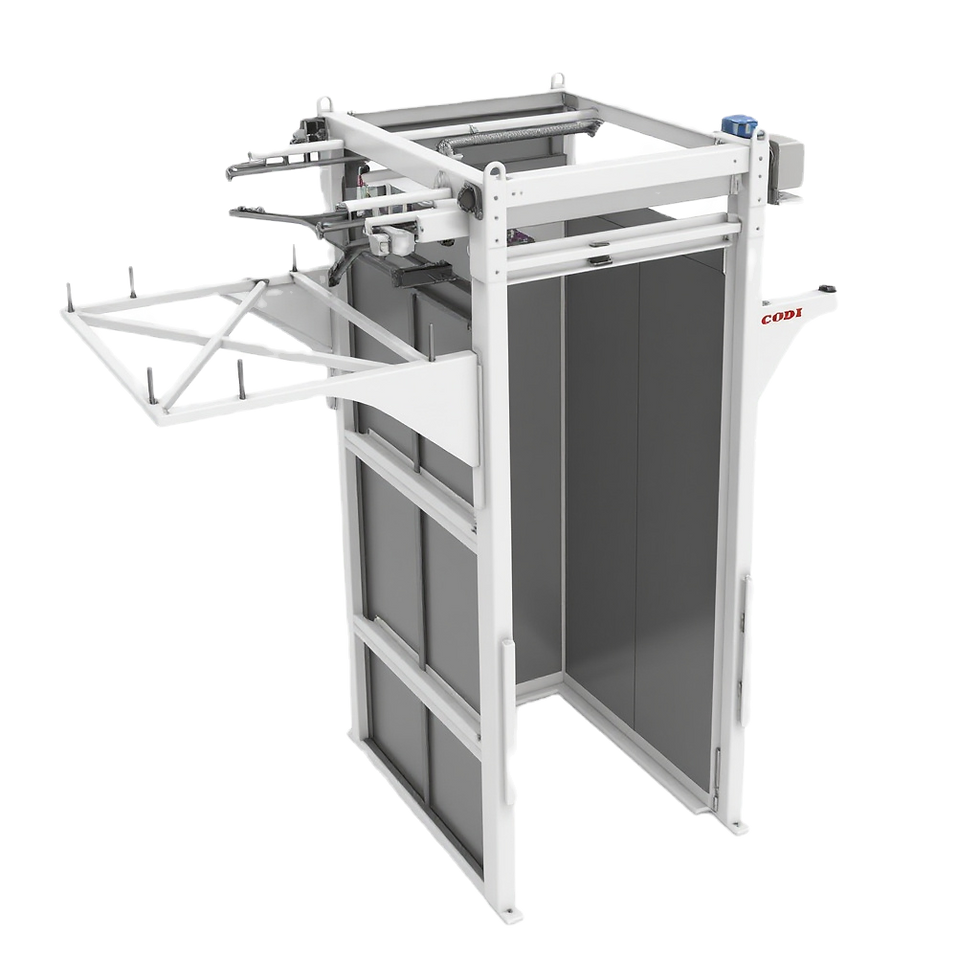
AUTOMATION: Automatic layer sweep
SPEED: ~250 CPM
SUITABLE FOR: Growing beverage producers
DPL-500 ENHANCED
DEPALLETIZER
_edited.png)
AUTOMATION: Automated
SPEED: ~500 CPM
SUITABLE FOR: Higher-volume lines
DPL-1000 HIGH-SPEED
DEPALLETIZER

AUTOMATION: Fully automated
SPEED: ~1,400 CPM
SUITABLE FOR: High-speed production

SELECTING A CAN DEPALLETIZER
Compare standard and optional features across the DPL-250, DPL-500, and DPL-1000 depalletizers. Final configurations depend on container type, pallet format, throughput, and facility requirements.
DPL SERIES
250
500
1000
Automated Hoist
✓
✓
✓
Encoder Positioning
✓
✓
✓
HMI Selection for Container Size
✓
✓
✓
Light Curtains
✓
✓
✓
Auto Pallet Infeed & Discharge
–
Opt
✓
Bulk Glass
Opt
Opt
Opt
Automated Door
Man. Door
Opt
✓
Sweep Front Gate (Pack Control)
–
✓
✓
Side Squaring (Pack Control)
–
✓
✓
Pallet Squaring / Uprighting
–
–
✓
Auto Controlled Sweep
–
✓
✓
Festo Linear Slide Guides
–
–
✓
Basic Dunnage Sorting & Storage
–
Opt
✓
Auto Top Frame Removal
–
✓
✓
Auto Dunnage Sorting & Storage
–
–
Opt
Vacuum Suction Cups
✓
✓
✓
Slip Sheet Storage
Opt
✓
✓
Auto Slip Sheet Removal & Placement
✓
✓
✓
Performance Level, Standard
–
PLc, Cat2
PLc, Cat 2
Performance Level, Upgradeable
–
PLd, Cat3
PLd, Cat 3
Codesys Controller, Web Touchscreen
–
✓
✓
PLC Plant Network, Ethernet/IP
–
✓
✓
Allen Bradley Upgrade
–
✓
✓
Half Height Pallets
✓
✓
✓
Pallet Conveying (Full & Empty)
–
Opt
✓
Pallet Stacking
–
Opt
✓
Organized Dunnage Collection
–
Opt
✓
Auto Dunnage Collection
–
–
Opt
Extended Container Height
Opt
Opt
Opt
HOW A DEPALLETIZER WORKS
Cans arrive at your facility on a pallet. Getting them off the pallet requires a depalletizer. Of course you can remove them by hand and feed them into a filler, but this gets tedious quickly. Simply put, a can depalletizer takes empty cans off the pallets they ship on and feeds them into your packaging line. It is usually the first automated step on the line, sitting ahead of the rinser and filler. Removing that manual handling stabilizes infeed, protects cans from damage, and keeps the rest of the line fed at a steady rate.
CODI's DPL-series depalletizers use a sweep design. A lift raises the pallet one layer at a time to a fixed sweep height, then a powered sweep pushes the full layer off the slip sheet and onto a conveyor.
Our automated DPL-250, 500, and 1000 models' capabilities are measured in cans per minute (CPM), and include more automated features as you scale up. These systems handle either cans or glass bottles. On automated models the slip sheet is removed, the empty pallet is discharged, and the next pallet is staged without an operator stepping in. An enclosed-chain counterbalance lift keeps the mechanical drive out of the can path, and VFD-controlled drives with encoder positioning let the lift stop at the right height on every layer. Higher-end models are fully featured, including an automatic door for added speed and ease of operation.

Our higher-end depalletizers are full featured, including an automatic door to provide increased speed and ease of operation.

Depalletizers generally fall into three types. Sweep systems are compact and cost-effective from low to high speeds and are what most can lines run. Gantry systems, like CODI's Flex Stack, handle heavier loads and mixed work at higher speed, which makes them good for boxes, bags, and other containers. Cobots, articulated robotic arms, can be good solutions where adequate floor space is available. The right choice comes down to your throughput, container sizes, changeover frequency, and floor space. As line speed climbs, automating the depalletizer is what keeps the front of the line from becoming the bottleneck.
DEPALLETIZER FAQ
A can depalletizer removes empty cans from inbound pallets and feeds them into a packaging line. It replaces the manual labor of unstacking cans by hand, delivering a consistent supply of containers to the rinser and filler downstream. Depalletizing is typically the first automation point on a beverage line.
Most can depalletizers, including CODI's DPL line, use a sweep design. The machine lifts a loaded pallet one layer at a time and a powered sweep pushes each full layer of cans off the slip sheet onto a conveyor. Automated models also strip the slip sheet, eject the empty pallet, and stage the next one, so cans keep moving without an operator unloading by hand.
On a semiautomatic depalletizer like the DPL-100, the operator raises the pallet and the sweep pushes the cans forward, which fits small spaces and mobile canning. A fully automatic system like the DPL-500 or DPL-1000 stages pallets, removes slip sheets, sweeps every layer, and discharges empty pallets on its own, holding high speeds without constant operator attention.
A depalletizer runs at the start of the line, taking empty cans off pallets and feeding them in. A palletizer runs at the end of the line, stacking finished, filled product back onto pallets for storage and shipping. CODI's RPL-1000 repalletizer and Flex Stack gantry handle the palletizing side.
Match the depalletizer to your line speed in cans per minute. The DPL-100 suits small and mobile operations, the DPL-250 runs up to 250 CPM, the DPL-500 up to 500 CPM, and the DPL-1000 up to 1,400 CPM. It is worth sizing for future growth, since the depalletizer sets the pace for everything downstream.
Footprint depends on the model and degree of automation. Higher-speed systems with pallet staging and automated infeed take more floor space than a compact semiautomatic unit, and full-height pallet handling needs adequate ceiling clearance. CODI configures each system to your container sizes, throughput, and facility constraints, so the layout fits the room you have.
Yes. CODI depalletizers can feed CODI equipment or integrate with compatible third-party rinsing, filling, seaming and packaging systems.
COMPLETE YOUR LINE